Motoring News
Do you trust your garage?
What 2,000 UK drivers really think about car quotes and repairs
Ryan Barham
Last updated: 03/09/2026
Ryan Barham
Last updated: 03/09/2026
Do you trust your garage? It’s a simple question but one that causes drivers all over the country headaches - especially those who need to find a new place for car maintenance, servicing, MOTs and repairs.
However, as reported in Motor Trade News, Tempcover research confirms the majority of drivers do have faith in their garage - with 83% trusting their repair recommendations.
This survey of 2,000 UK drivers also reveals what factors and affects driver confidence, and why electric vehicle owners face different challenges when it comes to trusting car garages.
History, transparency and honesty play a major part in garage trust:
Many drivers will also base their garage of choice on reputation, with 34% citing strong local standing or positive online reviews as a reason for their trust. Meanwhile, 28% say the garage simply confirms their suspicions about what was wrong, which reinforced their confidence.
Of the 5% of motorists who had doubts over a repair diagnosis:
This shows that customers appreciate plain language and upfront numbers when it comes to dealing with their car.
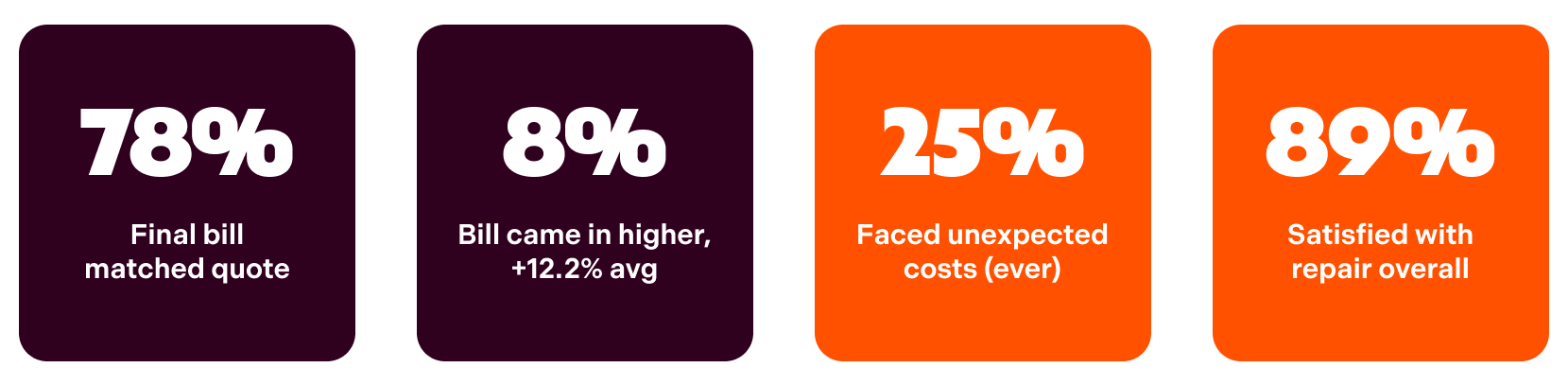
The quotes do tend to match the final bill with 78% of drivers saying their most recent quote matched the final invoice, and 89% being satisfied with the repair work overall.
Some drivers do still have surprises, with 25% saying they have experienced unexpected costs at a garage visit and 8% claiming their most recent bill came in higher than quoted - with an average of a 12.2% higher cost.
To retain and attract new customers, garages could focus on offering consistent quotes and invoices. Making things as simple as possible is likely to keep customers coming back, no matter how small their problem is.
Whether you drive a petrol or electric car, there are some habits that can help if you’re unsure about the garage you’re taking your car to:
Our survey found that EV drivers are less likely to trust their garage’s recommendations than petrol drivers, with only 77% believing their latest recommended repairs were genuinely necessary. Because the technology is newer, drivers naturally take a more cautious approach.
The results found that EV drivers tend to place their confidence in garages that can prove they are equipped for the job, rather than loyalty to a particular place like petrol drivers.
Another note of interest is that EV owners are four times more likely to be tied to a specific garage network through a finance, PCP, or warranty agreement (17%) than petrol drivers (4%). They also tend to value experience over cost (21%), a contrast to the 13% of petrol drivers who look for the lowest price.
If your car needs to stay in the garage for a few days, you don't have to stay off the road. Temporary car insurance lets you borrow a friend or family member's car for as long as you need it, from an hour to 28 days, so a repair doesn’t mean being stuck at home.
This online survey of 2,000 UK drivers was commissioned by RVU on behalf of Tempcover and conducted by market research company OnePoll, in accordance with the Market Research Society's code of conduct. Data was collected between 31st March and 7th April 2026. Unless otherwise specified, all insights are drawn directly from this survey's results.
We also currently hold an ‘Excellent’ rating on Trustpilot with over 50,000 reviews.