Learning to drive
Easiest and hardest places to pass your driving test
Ryan Barham
Last updated: 18/06/2026
Ryan Barham
Last updated: 18/06/2026
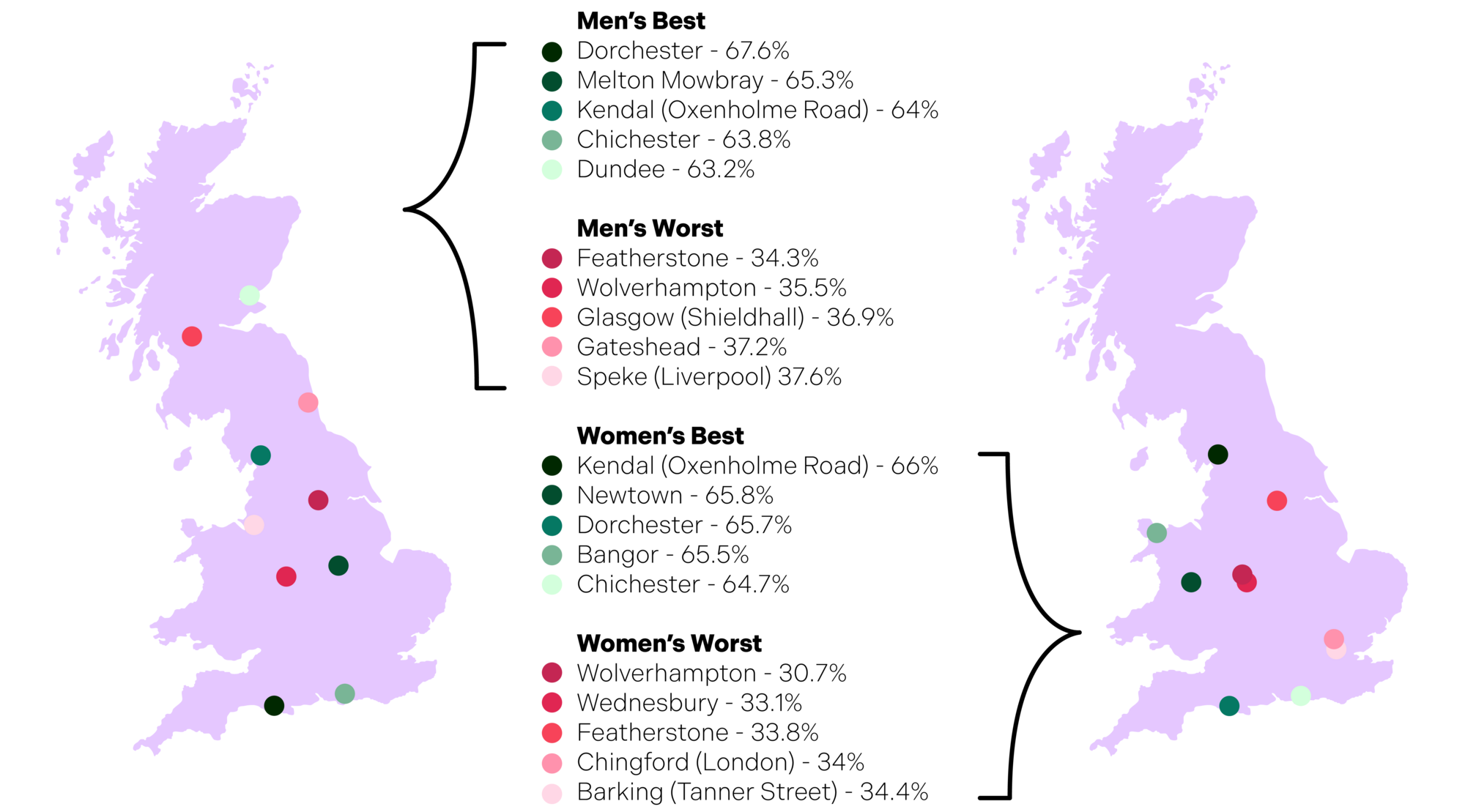
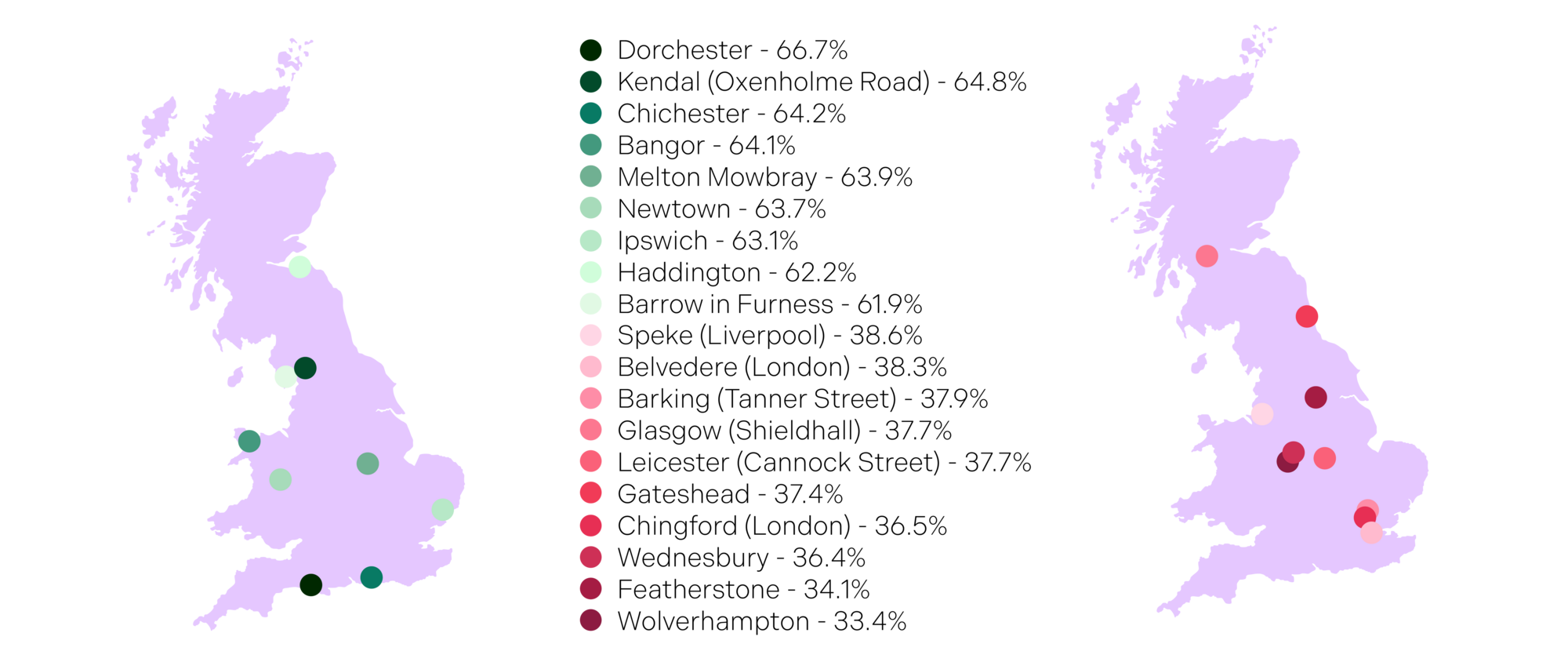
Driving test results show that the chances of learner drivers passing can vary depending on where they live in the UK.
The UK practical driving test first-time pass rate is around 47–49% for car tests. Pass rates vary significantly by test centre.
Some centres in rural areas have rates above 60%, while some busy urban centres see rates below 40%.
The theory test has a first-time pass rate of around 47 to 49%. Candidates who use structured revision materials consistently outperform those who don't.
 The most common driving test fails
The DVSA recently revealed the top reasons that UK learner drivers fail their driving test. These were found to be:
Peter Brabin, Head of Training at Bill Plant Driving School, commented: “What’s somewhat surprising is that a lot of the most common test failures are some of the very first things you’re taught when you get behind the wheel. That clearly just goes to show that maintaining a regular pattern of lessons is important to keep up the fundamentals. Nerves also play a part in the test experience which cause silly mistakes that you wouldn’t expect.
“While we obviously want as many learner drivers passing their driving test and enjoying the freedom on the road that many of us are fortunate enough to enjoy, this just goes to show why it’s imperative learner drivers are properly scrutinised on their test. None of us want unsteady, uncertain and unsafe drivers on the road, causing more accidents and issues and more rebooked driving tests.”
When breaking the data down according to gender, men stand a better chance of passing.
The national average pass rate for men is 49.5%. For women, the national average pass rate is 47.6%, almost two percentage points below their male counterparts and 1.2 percentage points below the combined overall national average.
With 7 passes out of 8 tests completed, the Isles of Scilly has the best pass rate when we include test centres that held under 1,000 tests.
It’s a similar story for other minor test centres, with Scotland’s Isle of Tiree and Inveraray also boasting pass rates over 80%.
It's worth noting that these areas have less than five miles of A-roads. Therefore, for an accurate overview of the easiest and hardest places to pass your driving test, it’s important to look at major centres.
Learner drivers in the UK can take their practical driving test from age 17 onwards.
Drivers aged 17 and under had the highest combined success rate with 65.27% of this age group in this area passing.
The lowest rate could be found from 57-year-olds who took their test in North England, where only 23.44% passed.
| East of England | East Midlands | London | North-east England | North-west England | South-east England | South-west England | West Midlands | Yorkshire and the Humber | Scotland | Wales | |
|---|---|---|---|---|---|---|---|---|---|---|---|
| 17 or under | 60.28% | 60.80% | 59.81% | 61.16% | 60.41% | 61.29% | 59.61% | 59.37% | 61.20% | 60.46% | 65.27% |
| 18 | 52.67% | 52.67% | 53.00% | 52.04% | 52.45% | 55.43% | 52.53% | 50.03% | 52.39% | 51.02% | 56.62% |
| 19 | 50.09% | 48.88% | 50.22% | 49.57% | 50.13% | 53.38% | 51.24% | 47.73% | 50.97% | 49.51% | 54.89% |
| 20 | 50.94% | 49.47% | 48.52% | 49.95% | 50.10% | 52.66% | 51.19% | 45.65% | 49.69% | 48.79% | 57.57% |
| 21 | 50.96% | 49.27% | 49.75% | 51.37% | 50.70% | 54.38% | 51.30% | 45.83% | 51.59% | 49.81% | 58.54% |
| 22 | 50.77% | 48.69% | 49.11% | 50.13% | 50.43% | 53.73% | 52.70% | 46.78% | 50.18% | 50.17% | 55.38% |
| 23 | 49.91% | 48.84% | 48.85% | 48.87% | 50.39% | 51.98% | 52.36% | 45.84% | 51.28% | 48.96% | 55.19% |
| 24 | 49.74% | 47.08% | 47.87% | 47.89% | 49.61% | 51.86% | 50.35% | 45.05% | 49.43% | 45.33% | 52.73% |
| 25 | 48.06% | 46.95% | 48.72% | 46.59% | 47.33% | 50.90% | 50.10% | 43.79% | 49.94% | 44.88% | 54.01% |
| 26 | 47.29% | 45.76% | 47.52% | 43.29% | 47.79% | 49.43% | 47.90% | 44.26% | 48.40% | 43.77% | 50.27% |
| 27 | 45.68% | 44.67% | 46.53% | 44.23% | 46.65% | 48.34% | 49.60% | 42.34% | 46.07% | 44.66% | 51.03% |
| 28 | 46.49% | 43.68% | 47.27% | 43.88% | 45.19% | 47.95% | 48.66% | 41.21% | 45.66% | 42.10% | 49.01% |
| 29 | 45.21% | 42.30% | 47.43% | 42.41% | 43.87% | 46.37% | 48.11% | 40.36% | 44.81% | 43.49% | 48.30% |
| 30 | 43.10% | 43.97% | 46.60% | 42.29% | 44.85% | 48.59% | 46.02% | 40.02% | 44.51% | 41.68% | 47.39% |
| 31 | 43.27% | 43.50% | 46.51% | 39.90% | 43.10% | 47.90% | 44.93% | 40.77% | 44.07% | 41.85% | 47.10% |
| 32 | 42.18% | 42.73% | 46.25% | 42.09% | 43.20% | 46.74% | 43.08% | 39.48% | 43.37% | 42.17% | 47.17% |
| 33 | 44.60% | 41.00% | 46.49% | 39.34% | 42.86% | 45.83% | 42.86% | 39.62% | 44.46% | 41.28% | 47.63% |
| 34 | 43.36% | 41.86% | 45.27% | 39.53% | 40.53% | 45.93% | 42.61% | 38.23% | 42.45% | 40.59% | 45.32% |
| 35 | 40.09% | 38.83% | 45.17% | 37.67% | 41.77% | 44.75% | 42.56% | 38.40% | 41.81% | 38.30% | 46.77% |
| 36 | 41.84% | 40.07% | 44.56% | 38.72% | 39.65% | 43.17% | 43.66% | 37.64% | 41.39% | 38.59% | 43.94% |
| 37 | 40.43% | 39.05% | 45.39% | 35.31% | 40.80% | 42.90% | 40.81% | 36.97% | 40.84% | 38.69% | 42.41% |
| 38 | 38.69% | 38.53% | 42.93% | 34.95% | 39.92% | 42.80% | 39.05% | 36.67% | 39.12% | 37.52% | 42.46% |
| 39 | 38.93% | 38.04% | 43.39% | 35.74% | 39.69% | 43.19% | 38.83% | 35.52% | 40.73% | 38.05% | 40.34% |
| 40 | 39.28% | 37.54% | 41.71% | 35.04% | 41.23% | 43.05% | 38.14% | 36.01% | 39.92% | 38.14% | 43.12% |
| 41 | 39.41% | 37.36% | 40.98% | 36.97% | 38.16% | 42.75% | 38.94% | 35.19% | 37.85% | 36.73% | 42.05% |
| 42 | 37.19% | 37.93% | 42.37% | 34.92% | 38.85% | 41.19% | 40.76% | 38.24% | 39.38% | 36.72% | 38.66% |
| 43 | 39.33% | 34.64% | 40.64% | 32.56% | 38.12% | 41.81% | 40.12% | 36.21% | 36.43% | 37.85% | 38.50% |
| 44 | 37.26% | 36.69% | 41.22% | 31.99% | 37.78% | 40.52% | 36.59% | 35.53% | 40.52% | 35.28% | 38.37% |
| 45 | 35.84% | 37.22% | 39.78% | 34.22% | 36.05% | 40.41% | 37.10% | 34.47% | 38.10% | 33.40% | 39.11% |
| 46 | 38.54% | 34.98% | 38.86% | 34.51% | 37.12% | 38.85% | 35.10% | 31.93% | 36.05% | 34.58% | 42.55% |
| 47 | 38.02% | 35.84% | 40.57% | 33.57% | 34.71% | 37.33% | 39.36% | 36.10% | 36.19% | 33.47% | 38.67% |
| 48 | 35.52% | 34.91% | 39.48% | 31.14% | 37.06% | 39.01% | 34.77% | 33.30% | 36.38% | 38.22% | 42.99% |
| 49 | 38.50% | 34.72% | 38.65% | 35.41% | 36.24% | 39.05% | 35.06% | 32.96% | 35.71% | 37.09% | 41.40% |
| 50 | 34.46% | 34.07% | 36.24% | 30.88% | 34.36% | 38.64% | 34.63% | 33.81% | 36.14% | 35.23% | 41.45% |
| 51 | 35.50% | 31.61% | 38.19% | 32.90% | 32.66% | 39.59% | 35.29% | 35.24% | 35.42% | 36.13% | 37.50% |
| 52 | 32.20% | 36.92% | 35.66% | 35.81% | 35.62% | 35.98% | 39.09% | 32.66% | 36.79% | 30.93% | 39.56% |
| 53 | 35.56% | 34.54% | 35.19% | 40.00% | 36.78% | 39.20% | 41.24% | 33.42% | 36.86% | 29.37% | 38.46% |
| 54 | 36.18% | 36.36% | 33.82% | 30.00% | 35.86% | 35.48% | 40.96% | 32.69% | 35.71% | 36.16% | 39.50% |
| 55 | 37.04% | 31.14% | 36.63% | 31.93% | 35.20% | 39.45% | 36.17% | 33.57% | 28.36% | 37.27% | 47.71% |
| 56 | 37.28% | 30.58% | 36.12% | 31.08% | 32.21% | 37.74% | 32.87% | 30.60% | 25.49% | 33.50% | 43.00% |
| 57 | 39.45% | 28.08% | 34.42% | 23.44% | 43.27% | 38.26% | 45.24% | 28.21% | 37.50% | 41.84% | 44.16% |
| 58 | 39.60% | 40.00% | 36.62% | 41.82% | 33.99% | 39.72% | 42.68% | 38.46% | 33.33% | 37.78% | 48.21% |
| 59 | 39.06% | 39.78% | 37.12% | 33.33% | 38.26% | 38.38% | 34.15% | 32.00% | 36.08% | 30.97% | 51.79% |
| 60+ | 37.44% | 33.67% | 33.99% | 33.33% | 35.47% | 43.47% | 37.50% | 32.23% | 38.18% | 35.39% | 46.93% |
Although there are still delays of up to six months when it comes to booking a driving test, you should stop and think before confirming the first one that is available.
Before choosing a test centre, you can factor in the pass rates while also looking at how busy the surrounding roads are, how familiar you are with the test routes and you can also speak to family, friends and your instructor for advice.
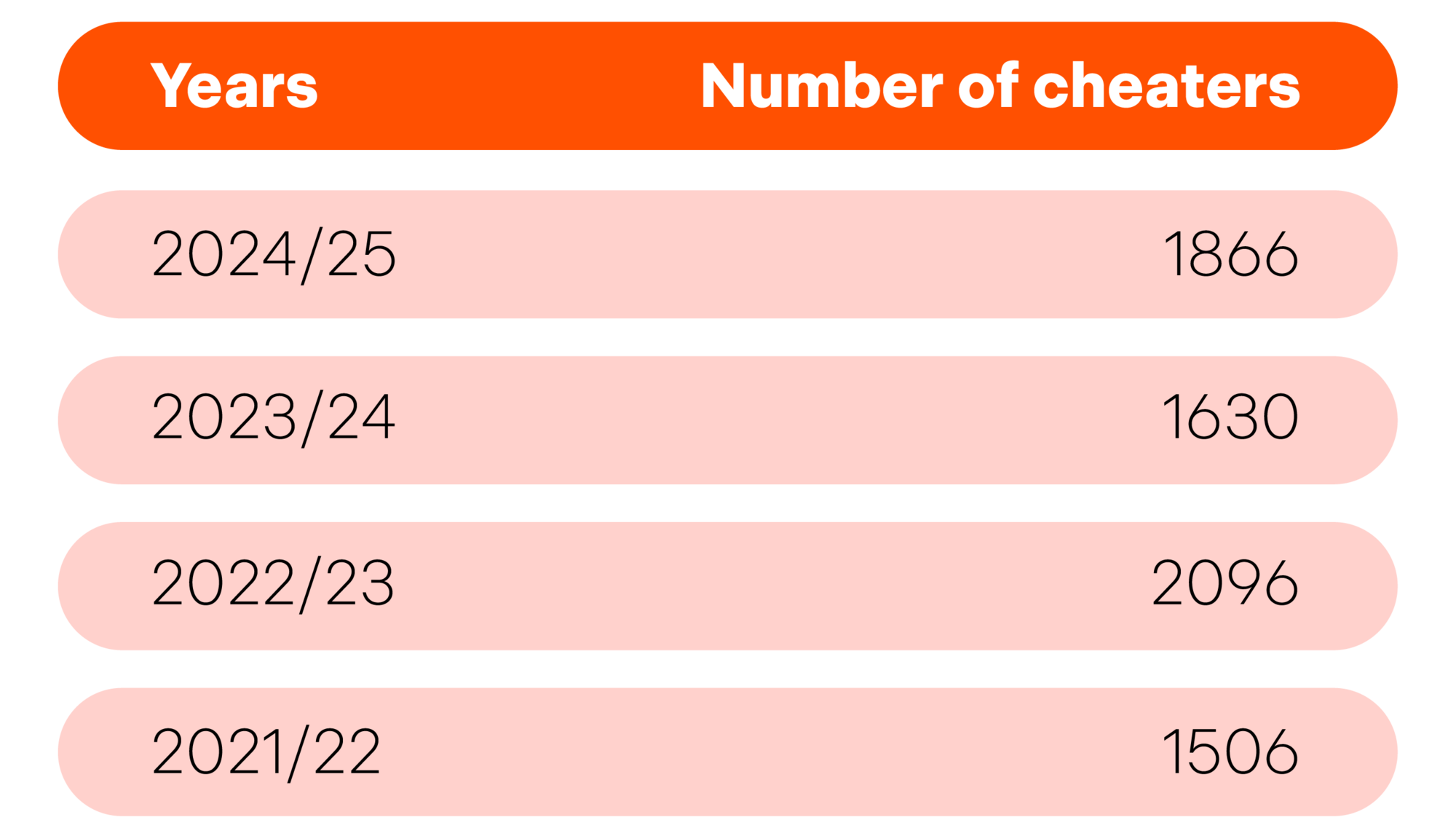
Even before taking their practical test, some desperate or dishonest would-be drivers could be tempted to cheat their way through passing their theory test.
In fact, the data revealed that cheating has skyrocketed over the years.
Our data revealed over 5,000 instances of theory test cheating between 2021 and 2024.
According to a BBC report, cheating methods can vary - from using technology like Bluetooth earpieces to hiring impersonators for up to £2,000 a time.
It goes without saying that it is illegal to cheat on your practical or theory test. Anyone caught using someone else to assist them in taking their test, or using an impersonator (as well as the impersonators themselves) can be:
In addition to being a criminal offence, cheating on a driving test also endangers the safety of other motorists, their passengers, and pedestrians as it enables unqualified drivers to be on the road.
If you were found to have obtained your licence by cheating, your car insurance policy could be invalidated as a result of you providing false or fraudulent information.
This will increase your risk profile, which could have the knock-on effect of future policy costs increasing or, in the worst-case scenario, make you completely uninsurable.
The data indicates that Sunday are a successful day for taking driving tests with three of the highest pass rates taking place on this day:
Learner drivers are required by law to be insured to drive, but they often do not require long-term cover and it may be costly to add them to a friend or family member’s policy.
This is where learner insurance comes in handy as it’s flexible to suit your needs, with policies lasting anywhere from just 1 hour to 28 days. It can help save on driving lesson costs as you take the car out with a friend or family member.
Our learner insurance provides fully comprehensive cover on every policy, providing you with complete peace of mind while you hone your driving skills.
This research data was sourced by conducting a freedom of information (FOI) request from the Driving and Vehicle Standards Agency (DVSA), based on a survey of major UK centres where 1,000 people or more took their driving tests between 2024 and 2025.
We also currently hold an ‘Excellent’ rating on Trustpilot with over 50,000 reviews.
You can pay for your short term insurance policy in several ways. Using our secure payment system, you can use the following payment methods:
After you’ve bought your policy, your documents will be emailed to you instantly so there’s no waiting around.
Get fully comprehensive cover on our standard short term policies - plus it won't affect your no claims discount
Choose the duration you want with 1-12 hour and 1-28 day cover available - don't pay for cover you don't need
Customise your policy to suit your specific situation - get the policy you want and even choose the minute you want your policy to begin