Learning to drive
What is nearside on a car?
Is it closer to the kerb or the driver?
Ryan Barham
Last updated: 03/06/2026
Ryan Barham
Last updated: 03/06/2026
If you’ve started your driving lessons or are preparing for your test, you’ve no doubt heard your instructor talking about offside and nearside.
You might be wondering why they’re using football terms but that’s not the case. You can forget about VAR and focus on the path instead…
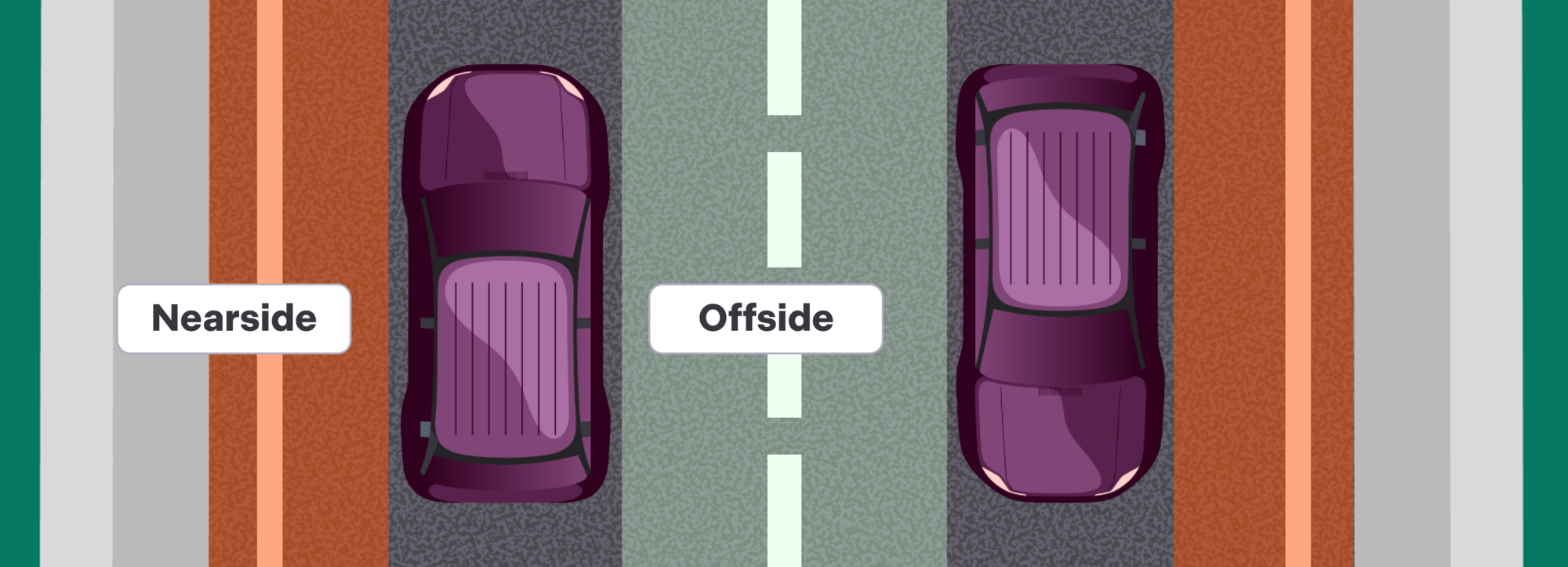
The terms nearside and offside are used to identify different parts of your vehicle:
As mentioned earlier, these vehicle terms have nothing to do with football. According to the Merriam-Webster dictionary, the term nearside was first coined in 1723. It was initially used to describe the side of a horse that riders needed to mount from.
The nearside was the left-hand side as riders would often wear swords on their left hip, meaning it was easier to swing their right leg over. Subsequently, the right side of the horse became known as the offside.
The left side is always the nearside. This means the nearside front tyre would be the one closest to the front passenger seat. Nearside rear refers to the back-left tyre on the passenger’s side and offside tyres will be the ones closest to the driver.
Term | Side of car | Also known as |
Nearside | Left | Passenger's side |
Offside | Right | Driver's side |
One of the simplest ways to remember nearside is it’s the side of your vehicle nearest to the kerb.
Meanwhile, the offside is off far away from the kerb. You could also think of next time you’re giving someone a lift. You’ll want them to be near safety when they get out of the car.
Yes, it’s well worth knowing about nearside and offside before you take both your theory and practical test.
The examiner will use this terminology and may ask you to pull over to the nearside or check a nearside mirror. Failing to do so could result in a minor error - and you’re only allowed a maximum of 15 of these before failing your test.
You’ll need to know the difference between the sides after passing your test. Whether you’re buying parts or dealing with repairs, you’ll want to get the right side when asking for a nearside tyre or bulb or telling a mechanic what side the issue is.
MOT certificates also specify defects via the terms nearside (NS) and offside (OS).
Many driving manoeuvres involve managing the nearside of the vehicle carefully. This is because it’s the furthest part away from your line of vision.
How far away are your nearside wheels and the kerb? Too close and you could damage your alloys. Too far away and your whole car could be too far out into the road, either causing a blockage or being at risk from oncoming traffic.
If you’re turning left, this will be a nearside turn. Always check the nearside mirror for cyclists or pedestrians who (as Musical Youth once almost sang) may be trying to pass you on the left-hand side…
Knowing which side of your car is offside and which is nearside is an important part of both learning to drive and independent driving once you have passed your test.
You’ll be able to understand what your instructor, examiner or supervisor (if practising with a friend or family using learner driver insurance) are asking you to do and could soon be on the road to success.
Nearside on a car is the side closest to the kerb. In the UK, this is the passenger side.
The left side (or passenger side) is always the nearside. This means the the right-hand side is offside (or the driver’s side).
Nearside is the side of your vehicle nearest to the kerb. You can also remember that you want your passenger to be near safety.
Nearside and offside could come up in your driving test as examiners are likely to use this terminology e.g. asking you to pull over to the nearside or check a nearside mirror.
Related tags:
Temporary Car InsuranceWe also currently hold an ‘Excellent’ rating on Trustpilot with over 50,000 reviews.